Tag Archive for: Sippy Cup

There’s a lot to think about when you’re having a baby, so many needs to consider – cribs, strollers, clothing, diapers, baby bottles, bassinets, and more. Needless to say, choosing the best and safest products for your infant, toddler, or young child can be a dizzying process, especially when you’re bombarded with so many product choices.

But how to know if you’re buying something that poses a serious risk? An easy way to stay informed is to register with the Consumer Product Safety Commission (cpsc.gov) to receive their email alerts that identify dangerous products and provide information about their risks. They also have an app you can download to your phone. You can find that here. This is a must-have resource. Adult-related products are included as well.

We went over all the alerts that were issued this year up to the writing of this article and identified a number of product categories that seem to continually pose a health and safety risk where infants and toddlers are concerned. And the list of products grows every day.

Here’s a sample of our findings…

  • Several baby bathing seats that are unsafe and present an increased risk of drowning
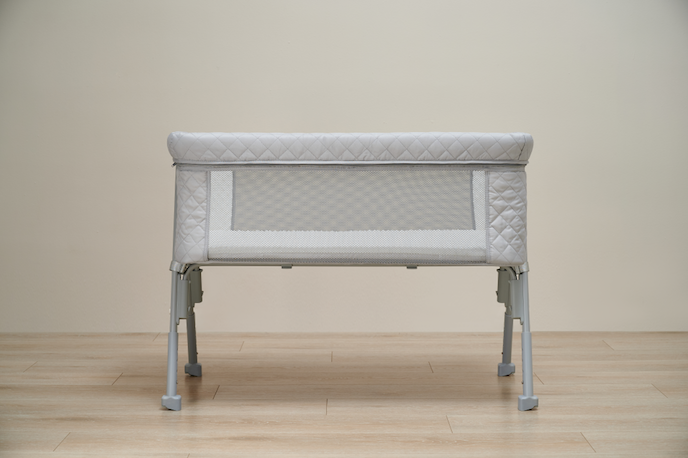
  • Bassinets which are unsafe for infants, increasing the risk of suffocation or entrapment
  • One or more baby gates that do not meet safety standards
  • More than a few chests of drawers that are top heavy and are easy to tip over by a small child causing serious injury

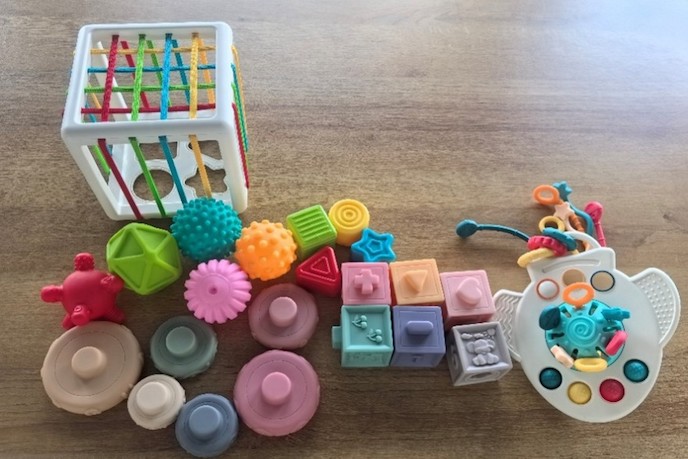
  • Numerous toys, games and other items powered by small batteries that, if placed in
    the mouth, increase both a choking risk as well as a risk for toxic ingestion
  • Several safety helmets for those starting to ride a bike or skateboard that are not
    adequate for protection of the head
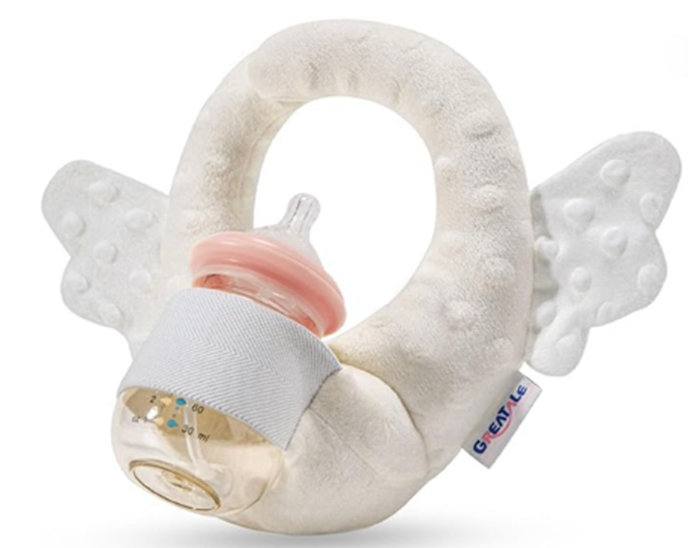
  • Several “self-feeding” pillows with attachments for a small bottle that pose a
    choking risk
  • Any number of medications and/or supplements that violate child resistant
    packaging and can lead to serious or lethal toxic ingestion
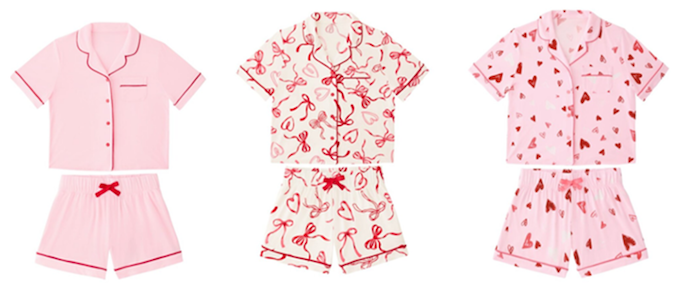
  • Infant & toddler bedtime clothing that do not meet flammability standards
There are also a significant number of items that adults use regularly including:

  • Power strips for multiple electrical inputs that pose a fire risk
  • Steam cleaners due to risk of serious burns
  • A number of pool or hot tub drain covers which increase the risk of entrapment and
    drowning
  • Several adult portable side rails that increase the risk of serious falls


Save a Little Life strongly encourages all parents to register with the CPSC. Here’s a direct link to subscribe to their mailing list.


BE PREPARED. BE SAFE.
 

When to initiate semi-solid and then solid food for your baby is one of the most commonly asked questions during our Pediatric CPR & Family Safety classes. These concerns are clearly associated with the risk of choking. We fully understand these anxieties and do our best to help families be prepared to deal with them.

Our friends at Beverly Hills Pediatrics have provided a very helpful set of guidelines to make the process easier and less stressful.

Answers to the following questions will help you get started.

WHEN CAN YOUR BABY EAT SOLID FOODS?

They are typically ready between 4 and 6 months of age. By this time, they have improved their head, tongue, and mouth coordination.

It is advisable to start with pureed foods that an infant can manage more easily. These foods should not necessarily replace breast or formula feeding but are an addition to those other valuable nutrients.

An infant is ready to begin this process when they display certain signs of readiness, in particular, the ability to sit upright with minimal or no support from a parent or care provider.

Close focus and attention to the infant is always essential for safety.

4-8 MONTHS

New research shows that introducing a wide variety of foods as early as possible is important for developing adventurous eaters and may be important in reducing the risk of food allergies.

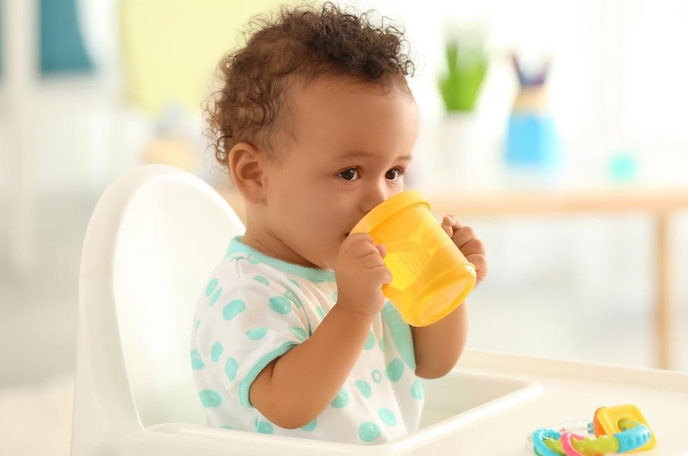
At 6 months you can start introducing water via a “sippy cup” or straw.

Shows a baby boy in a high chair drinking from a yellow sippy cup

During infancy the only food you should avoid is honey as it is not tolerated well and could cause botulism.

WHAT ABOUT FOOD ALLERGIES? WHAT, IF ANYTHING SHOULD WE AVOID?

The introduction of more allergenic foods (peanuts, tree nuts, eggs, dairy and fish) early and frequently helps reduce rates of allergies. Our experts suggest including small amounts of these foods in your child’s diet 2-3 times per week. However, if your little one has a history of severe eczema or a family history of severe allergies please consult with your pediatrician before starting these foods.

It is advised to avoid processed foods while aiming for whole ingredients. You can start with spooning small amounts of food(s) and observe the natural process that we all possess at this young age.

Remember, babies love the taste of food just as we do so if you want to puree your entire dinner and offer it in small amounts to your baby, go for it!

8-12 MONTHS

At this age you should feel safe offering them finger foods. At this point, please make sure that the size of the food is small enough so pieces can dissolve more easily. Start with pea-sized bites and advance slowly. Some larger foods that might seem too big such as bananas or whole cooked carrots and sweet potatoes are good, healthy examples.

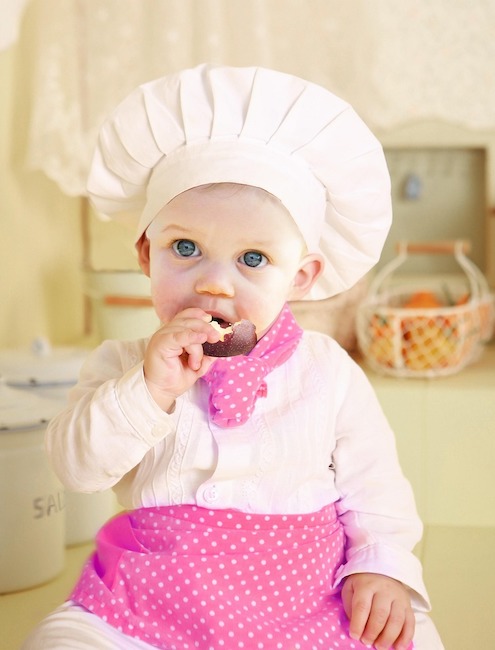
Shows a baby girl eating a piece of apple while sittiing on a counter wearing chef whites with a pink scarf and a pink skirt.

Encourage them to try a variety of mild spices and flavors yet try to avoid over salting their foods as excess sodium isn’t good for any of us.

By this time many clinicians suggest decreasing breast feeding to 3-5 times per day and formula intake from 29-32 oz. per day to 16-24 oz. per day.

FOODS TO AVOID

Some foods are just too risky and can increase the risk of choking. These include popcorn, whole nuts, whole grapes or any hard foods until at least the age of three.

Beyond this age parents and care providers need to continue to observe them while eating in case of an unexpected choking event.

BE PREPARED, JUST IN CASE!

Parents, family members, and care providers need to be prepared in case of a true choking event. All adults who care for little ones must take a CPR course to learn how to resolve this emergency. Remember, paramedics will never be there in time to assist in a severe choking episode.