Tag Archive for: CPR

Several years ago, I had an experience with my pug after giving her one of those hard, dehydrated, chicken strips for a snack. Almost immediately, she stopped breathing. I could see that she was fully obstructed, so I stood her up on her hind legs and attempted to perform the Heimlich maneuver. The first upward thrust didn’t clear her airway, so I tried it again (a bit harder) and out it came! A close call, for sure. Needless to say, I don’t recommend this type of snack as it poses a very high risk of choking.

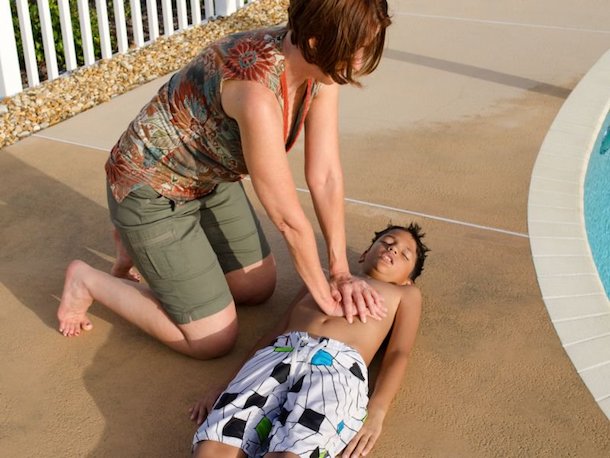
But what could I have done if she had lost consciousness, or was pulled lifeless from a swimming pool? Is it possible to administer CPR for a dog or cat and how effective can it be?

Dr. Jamie Burkitt is an associate professor of Clinical Small Animal Emergency and Critical Care Service at the University of California, Davis. She also co-chairs an initiative spearheaded by a team of veterinary emergency and critical care specialists called The Recover Initiative. Not only does The Recover Initiative provide up-to-date evidence-based veterinary CPR guidelines, they offer affordable online classes to pet owners and pet professionals who want to learn these skills.


HOW TO KNOW IF YOUR DOG OR CAT NEEDS CPR?

According to Dr. Burkitt, pets, unlike humans whose heart’s may stop suddenly and without warning, will (most of the time) give some indication that they’re ill before their heart actually stops beating.  Typically, these signs & symptoms include rapid or irregular breathing, lethargy, loss of appetite or excessive vomiting. If things continue to deteriorate and the animal becomes unresponsive you need to act.

Should this occur, do not call 9-1-1, begin CPR instead and have someone call the nearest veterinary hospital and let them know you are on your way.  If someone else is driving you can continue to perform CPR on the way.


WHERE DO I DO CHEST COMPRESSIONS ON A DOG?

This varies depending on the size and breed of the dog. Chest compressions are typically done with the animal on their side but with dogs who have wider chests like an English Bulldog, for instance, it is better to do compressions while they’re on their back.
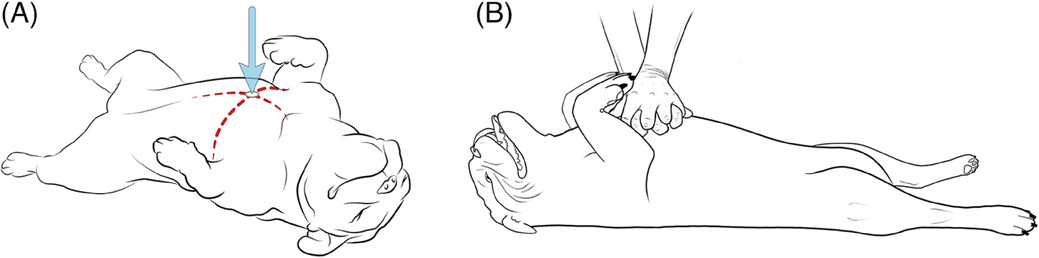
For round chested dogs such as retrievers, give compressions at the widest part of the chest. This should be done in the middle of their breastbone.

For medium and larger dogs, the rescuer should position themselves at the side, lock fingers together and keep your elbows locked, not bent, to achieve better quality compressions.

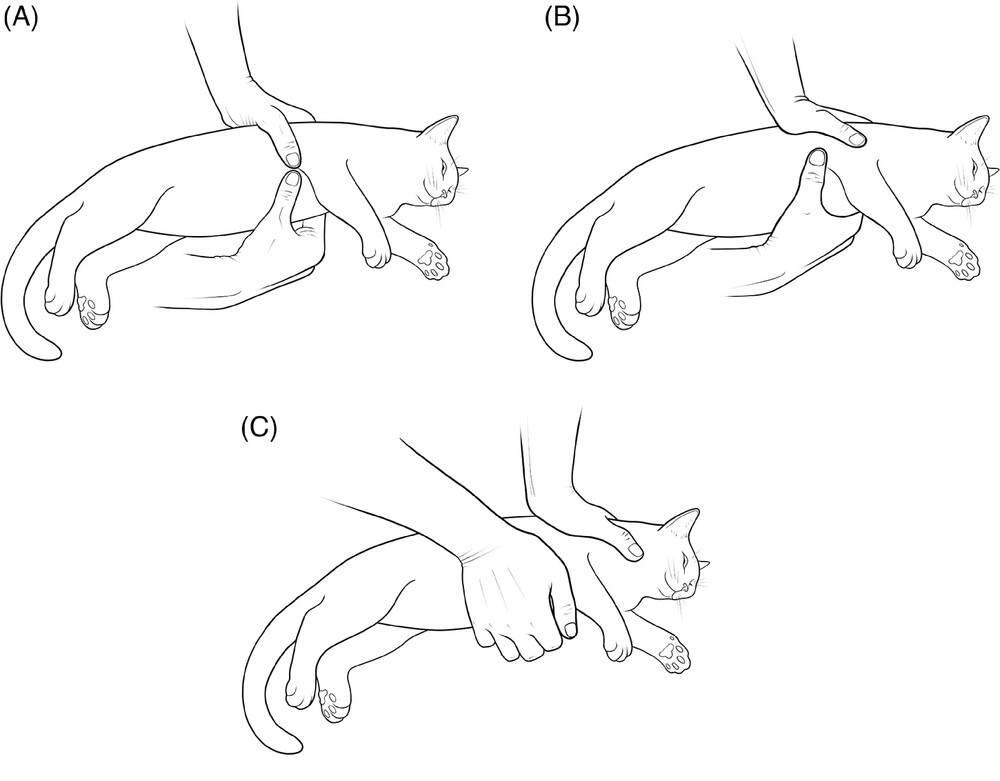
For smaller dogs or cats, use an overlapping, two handed compression method with your hands under their body and use your thumb(s) to provide the compressions.
Similar to human CPR the compression to rescue breathing ratio is 30 compressions: 2 breaths.  Again, following the human format, the number of compressions per minute should be between 100-120 per minute.  When delivering the rescue breaths encircle the nostrils of the animal with your lips to make a tight seal and blow hard enough to see or feel the chest rise.

Dr. Burkitt noted that there is little risk in administering CPR to a cat or dog and that the potential risk(s) are small compared to the need for life saving support.

Download a copy of the latest edition (2024) RECOVER CPR Guidelines here.

Information on The Recover Initiative Animal CPR and First Aid Course for Pet Owners and Pet Professionals is available here.

More information on CPR for Pets is available through The American Red Cross.

When to initiate semi-solid and then solid food for your baby is one of the most commonly asked questions during our Pediatric CPR & Family Safety classes. These concerns are clearly associated with the risk of choking. We fully understand these anxieties and do our best to help families be prepared to deal with them.

Our friends at Beverly Hills Pediatrics have provided a very helpful set of guidelines to make the process easier and less stressful.

Answers to the following questions will help you get started.

WHEN CAN YOUR BABY EAT SOLID FOODS?

They are typically ready between 4 and 6 months of age. By this time, they have improved their head, tongue, and mouth coordination.

It is advisable to start with pureed foods that an infant can manage more easily. These foods should not necessarily replace breast or formula feeding but are an addition to those other valuable nutrients.

An infant is ready to begin this process when they display certain signs of readiness, in particular, the ability to sit upright with minimal or no support from a parent or care provider.

Close focus and attention to the infant is always essential for safety.

4-8 MONTHS

New research shows that introducing a wide variety of foods as early as possible is important for developing adventurous eaters and may be important in reducing the risk of food allergies.

At 6 months you can start introducing water via a “sippy cup” or straw.

Shows a baby boy in a high chair drinking from a yellow sippy cup

During infancy the only food you should avoid is honey as it is not tolerated well and could cause botulism.

WHAT ABOUT FOOD ALLERGIES? WHAT, IF ANYTHING SHOULD WE AVOID?

The introduction of more allergenic foods (peanuts, tree nuts, eggs, dairy and fish) early and frequently helps reduce rates of allergies. Our experts suggest including small amounts of these foods in your child’s diet 2-3 times per week. However, if your little one has a history of severe eczema or a family history of severe allergies please consult with your pediatrician before starting these foods.

It is advised to avoid processed foods while aiming for whole ingredients. You can start with spooning small amounts of food(s) and observe the natural process that we all possess at this young age.

Remember, babies love the taste of food just as we do so if you want to puree your entire dinner and offer it in small amounts to your baby, go for it!

8-12 MONTHS

At this age you should feel safe offering them finger foods. At this point, please make sure that the size of the food is small enough so pieces can dissolve more easily. Start with pea-sized bites and advance slowly. Some larger foods that might seem too big such as bananas or whole cooked carrots and sweet potatoes are good, healthy examples.

Shows a baby girl eating a piece of apple while sittiing on a counter wearing chef whites with a pink scarf and a pink skirt.

Encourage them to try a variety of mild spices and flavors yet try to avoid over salting their foods as excess sodium isn’t good for any of us.

By this time many clinicians suggest decreasing breast feeding to 3-5 times per day and formula intake from 29-32 oz. per day to 16-24 oz. per day.

FOODS TO AVOID

Some foods are just too risky and can increase the risk of choking. These include popcorn, whole nuts, whole grapes or any hard foods until at least the age of three.

Beyond this age parents and care providers need to continue to observe them while eating in case of an unexpected choking event.

BE PREPARED, JUST IN CASE!

Parents, family members, and care providers need to be prepared in case of a true choking event. All adults who care for little ones must take a CPR course to learn how to resolve this emergency. Remember, paramedics will never be there in time to assist in a severe choking episode.

Drowning is a major concern worldwide.

Water is a source of joy for children of all ages but it requires a high degree of respect and caution. 

These days drowning is newly defined as “submersion in a liquid” and doesn’t assume death which may be confusing. That is why the American Academy of Pediatrics (AAP), The Center for Disease Control (CDC) and the World Health Organization (WHO) all want us to have a better understanding not only of what it is, but how drowning can affect anyone, and how it impacts society.

Too often we assume that little ones are safe in water unless we hear a lot of splashing or a call for help but sadly, these responses rarely occur. Drowning is quick and silent. That is why it’s crucial that you be informed as to what actually happens when someone is in real trouble.  

Practicing life-saving skills is the responsibility of everyone involved in the care of your children. 

Save A Little Life works with all parents, family members, and trusted care providers regarding the risks, how drowning actually happens, and where it occurs.  We continue to emphasize the importance of drowning prevention and, of course, what we would need to do in the event of a real health emergency.  One thing we emphasize is that drowning victims can be saved if we recognize the problem and start CPR immediately.

Below you’ll find the latest statistics on drowning. We encourage you to read them carefully with the understanding that our intention is not to scare you but to inspire you.

As we like to say, Be Informed. Be Prepared. Be Safe.

GENERAL STATISTICS:

  • There is an average of 4,012 unintentional drownings per year
  • Drowning remains among the top 4 causes of death from age 54 and up
  • Drowning is the single leading cause of death for children ages 1-4, and the second leading cause of injury-related death for children up to 14 years old
  • The U.S. averages 11 fatal drownings per day and an average of 22 non-fatal drownings per day
  • More than 40% of drownings treated in Emergency Departments require hospitalization, transfer or further care (compared with 8% of all unintentional injuries). Many of those who do not die will experience brain damage or other serious outcomes, often with long term disability
  • Drowning can occur in as little as 20-60 seconds
  • Nearly 80% of drowning deaths are among males due to increased exposure to water, risk-taking behavior and alcohol use

CHILD STATISTICS:

  • 88% of child drownings occur with at least 1 adult present
  • For every child that dies from drowning, another 7-8 require emergency department care for non-fatal drowning.  Nearly 70% of drownings of young children occur during non-swimming times
  • Two of three drowning incidents that take place in the home occur in a bathtub
  • 23% of child drownings happen during a family gathering near a pool

RACIAL AND ETHNIC GROUP STATISTICS:

  • Drowning deaths rates for Black people are 1.5 times higher than the rates for White people.  These disparities are highest among Black children  ages 5-9
  • In swimming pools, Black children ages 10-14 years drown at rates 7.6 times higher than White children
  • Black children are more likely to drown in public pools, and White children and youth in residential pools
  • Drowning rates for Native American or Alaskan Native people ages 29 and younger are 2 times higher than the rates for White people

STATISTICS FOR PEOPLE WITH DISABILITIES AND MEDICAL CONDITIONS: 

  • People with seizure disorders such as epilepsy are at a higher risk of fatal and non-fatal drowning than the general population  
  • Other conditions such as autism and heart conditions are also associated with a higher risk of drowning

Let us all be informed and prepared.  There is so much as stake.

Why Does My Nanny Need CPR and First Aid Training?

The question posed above is a good one. The answer I usually provide anyone who asks why their caregiver needs a life-saving course is: “Do we really have control over when bad events occur at home or anywhere else?” That answer suggests that parents stop and think about this issue. Their answer is usually self-evident. Of course we don’t.
Emergencies in the home have little or no warning as to when they will occur. This is why we emphasize the importance of two main areas: Prevention and, if and when needed, action.

The program offered by Save A Little Life ™ addresses and re-focuses on these two critical areas. The responsibilities we give our nannies/care-providers are awesome. They are not only your eyes and ears when parents are away from home, they really need the exact same understanding of how we prevent and, importantly when and how we act.

Simply and accurately put, they perform the most important job you will ever hire for. The vast majority of your home based help are smart, interested and utterly committed to your infant, toddler and child’s well-being. It is the parent’s job to make sure you are leaving your little ones in prepared hands.

First Aid and little ones

The first-aid component of the course is far more likely to be required. Cuts, bumps, splinters, head bonks and the like are quite common. Our experienced instructors review the most common of these incidents so that your nanny will be able to be decisive in their action. These actions may include:

* Responding to the more minor incidents noted above.
* Be able to understand when an injury, for example, needs the parent’s attention right away.
* Should be confident in explaining a situation that has occurred and do so succinctly and in a timely way.
* The competent use of first-aid supplies provided by the parent at home or elsewhere.
* Do their best to identify injuries or accidents that may require a visit to the E.R.
* Quickly identify higher risk concerns in or near your home where quick action may be needed to safeguard your small ones.

What we do

Save A Little Life ™ specializes in Pediatric CPR and First Aid for families and caregivers. Ask us about family discounts for those who have taken our class recently and need to have a caregiver trained too. Don’t wait!

Our next two certification courses are as follows:

Westside Nannies (En Espanol)
July 15, 2017
(Ask about our Special for this class, now through June 13, 2017!)
Westside Nannies (English)
July 22, 2017
Parents are welcome too, of course!

Have a safe and prosperous summer
Richard Pass, RN ,BS
Founder and Owner of Save A Little Life, inc.