Tag Archive for: Food Allergies

At a recent meeting of the American Academy of Pediatrics there was a wide-ranging discussion of popular myths about pediatric allergies. Discussions included topics such as First vs Second Generation Antihistamines, Local Organic Honey for Treatment of Allergies, How to Diagnose Cow’s Milk Allergies, Penicillin Allergies and Treatment of Hives.

Another issue, very relevant to breast feeding mothers, is whether there is a need to eliminate foods that might be passed along to infants in breast milk. The discussion was led by David Stukus, MD, a professor of clinical pediatrics in the division of Allergy and Immunology at Nationwide Children’s Hospital, Columbus, Ohio.

Stukus explained that breastfeeding mothers do not typically pass allergens to their infants in breastmilk, “so it is rare that a mother would need to eliminate anything from her diet if her baby experiences atopic dermatitis, colic, GI reflux or similar symptoms.”

Dr. Stukus also addressed other allergy-related misconceptions including:

  • There is no need to wait a certain number of days between introducing new foods to infants. He suggested letting babies explore new foods and textures at each mealtime and to reassure families that 95% of children never develop food allergies. In reality, he said, “early and ongoing consumption of different foods has the greatest likelihood of preventing food allergies.
  • Egg allergy is not a contradiction to the flu, measles, mumps rubella and yellow fever vaccines. Again, he is quoted…“Despite concerns about a theoretical risk that vaccines made using chick embryos could cause an allergic reaction, the evidence has shown otherwise, and allergy to a vaccine ingredient is not usually a contradiction to receiving it.”
  • When comparing first vs second generation antihistamines parents should consider not using diphenhydramine (Benadryl) in favor of newer antihistamines such as Zyrtec or Claritin as they have a quicker onset with fewer side effects. 

    It is vital that all young families speak with their own pediatricians regarding food allergies, various treatments, or any other issues that you are concerned about.
When to initiate semi-solid and then solid food for your baby is one of the most commonly asked questions during our Pediatric CPR & Family Safety classes. These concerns are clearly associated with the risk of choking. We fully understand these anxieties and do our best to help families be prepared to deal with them.

Our friends at Beverly Hills Pediatrics have provided a very helpful set of guidelines to make the process easier and less stressful.

Answers to the following questions will help you get started.

WHEN CAN YOUR BABY EAT SOLID FOODS?

They are typically ready between 4 and 6 months of age. By this time, they have improved their head, tongue, and mouth coordination.

It is advisable to start with pureed foods that an infant can manage more easily. These foods should not necessarily replace breast or formula feeding but are an addition to those other valuable nutrients.

An infant is ready to begin this process when they display certain signs of readiness, in particular, the ability to sit upright with minimal or no support from a parent or care provider.

Close focus and attention to the infant is always essential for safety.

4-8 MONTHS

New research shows that introducing a wide variety of foods as early as possible is important for developing adventurous eaters and may be important in reducing the risk of food allergies.

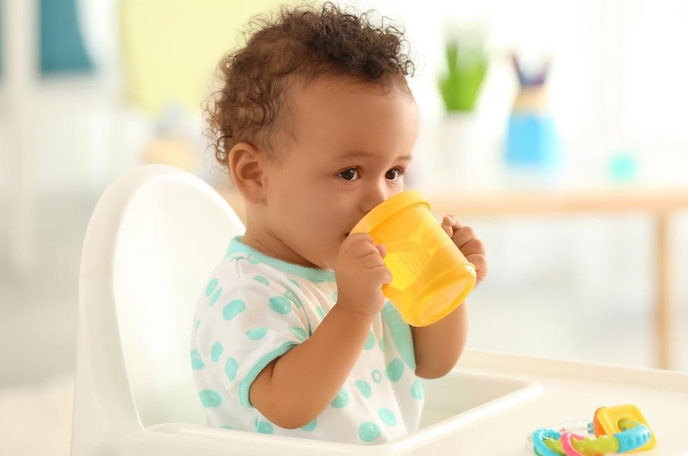
At 6 months you can start introducing water via a “sippy cup” or straw.

Shows a baby boy in a high chair drinking from a yellow sippy cup

During infancy the only food you should avoid is honey as it is not tolerated well and could cause botulism.

WHAT ABOUT FOOD ALLERGIES? WHAT, IF ANYTHING SHOULD WE AVOID?

The introduction of more allergenic foods (peanuts, tree nuts, eggs, dairy and fish) early and frequently helps reduce rates of allergies. Our experts suggest including small amounts of these foods in your child’s diet 2-3 times per week. However, if your little one has a history of severe eczema or a family history of severe allergies please consult with your pediatrician before starting these foods.

It is advised to avoid processed foods while aiming for whole ingredients. You can start with spooning small amounts of food(s) and observe the natural process that we all possess at this young age.

Remember, babies love the taste of food just as we do so if you want to puree your entire dinner and offer it in small amounts to your baby, go for it!

8-12 MONTHS

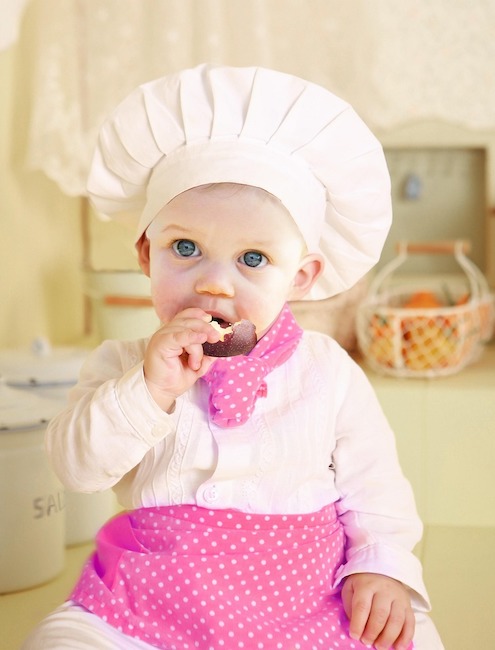
At this age you should feel safe offering them finger foods. At this point, please make sure that the size of the food is small enough so pieces can dissolve more easily. Start with pea-sized bites and advance slowly. Some larger foods that might seem too big such as bananas or whole cooked carrots and sweet potatoes are good, healthy examples.

Shows a baby girl eating a piece of apple while sittiing on a counter wearing chef whites with a pink scarf and a pink skirt.

Encourage them to try a variety of mild spices and flavors yet try to avoid over salting their foods as excess sodium isn’t good for any of us.

By this time many clinicians suggest decreasing breast feeding to 3-5 times per day and formula intake from 29-32 oz. per day to 16-24 oz. per day.

FOODS TO AVOID

Some foods are just too risky and can increase the risk of choking. These include popcorn, whole nuts, whole grapes or any hard foods until at least the age of three.

Beyond this age parents and care providers need to continue to observe them while eating in case of an unexpected choking event.

BE PREPARED, JUST IN CASE!

Parents, family members, and care providers need to be prepared in case of a true choking event. All adults who care for little ones must take a CPR course to learn how to resolve this emergency. Remember, paramedics will never be there in time to assist in a severe choking episode.