• Shopping Cart Shopping Cart
    0Shopping Cart
Save a Little Life
  • HOME
  • ABOUT
    • SAVE A LITTLE LIFE
    • OUR TEAM
  • CLASSES
    • CERTIFICATION CLASSES
    • NON-CERTIFICATION CLASSES
    • CLASES EN ESPAÑOL
    • VIRTUAL CLASSES
  • FAQ
  • CALENDAR
  • GALLERY
  • SAFETY CORNER
  • SHOP
  • RESOURCES
  • CONTACT
  • Menu Menu

Tag Archive for: Pediatric

Child Development, Choking, Feeding Stages

INTRODUCING SOLID FOODS TO YOUR INFANT – When, What, How

When to initiate semi-solid and then solid food for your baby is one of the most commonly asked questions during our Pediatric CPR & Family Safety classes. These concerns are clearly associated with the risk of choking. We fully understand these anxieties and do our best to help families be prepared to deal with them.

Our friends at Beverly Hills Pediatrics have provided a very helpful set of guidelines to make the process easier and less stressful.

Answers to the following questions will help you get started.

WHEN CAN YOUR BABY EAT SOLID FOODS?

They are typically ready between 4 and 6 months of age. By this time, they have improved their head, tongue, and mouth coordination.

It is advisable to start with pureed foods that an infant can manage more easily. These foods should not necessarily replace breast or formula feeding but are an addition to those other valuable nutrients.

An infant is ready to begin this process when they display certain signs of readiness, in particular, the ability to sit upright with minimal or no support from a parent or care provider.

Close focus and attention to the infant is always essential for safety.

4-8 MONTHS

New research shows that introducing a wide variety of foods as early as possible is important for developing adventurous eaters and may be important in reducing the risk of food allergies.

At 6 months you can start introducing water via a “sippy cup” or straw.

Shows a baby boy in a high chair drinking from a yellow sippy cup

During infancy the only food you should avoid is honey as it is not tolerated well and could cause botulism.

WHAT ABOUT FOOD ALLERGIES? WHAT, IF ANYTHING SHOULD WE AVOID?

The introduction of more allergenic foods (peanuts, tree nuts, eggs, dairy and fish) early and frequently helps reduce rates of allergies. Our experts suggest including small amounts of these foods in your child’s diet 2-3 times per week. However, if your little one has a history of severe eczema or a family history of severe allergies please consult with your pediatrician before starting these foods.

It is advised to avoid processed foods while aiming for whole ingredients. You can start with spooning small amounts of food(s) and observe the natural process that we all possess at this young age.

Remember, babies love the taste of food just as we do so if you want to puree your entire dinner and offer it in small amounts to your baby, go for it!

8-12 MONTHS

At this age you should feel safe offering them finger foods. At this point, please make sure that the size of the food is small enough so pieces can dissolve more easily. Start with pea-sized bites and advance slowly. Some larger foods that might seem too big such as bananas or whole cooked carrots and sweet potatoes are good, healthy examples.
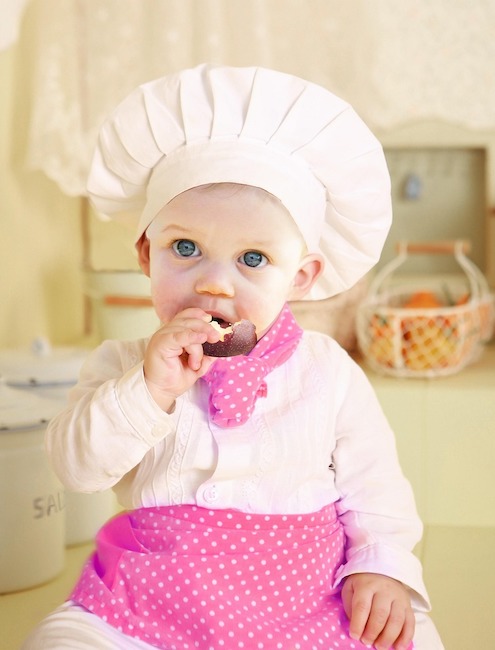
Shows a baby girl eating a piece of apple while sittiing on a counter wearing chef whites with a pink scarf and a pink skirt.

Encourage them to try a variety of mild spices and flavors yet try to avoid over salting their foods as excess sodium isn’t good for any of us.

By this time many clinicians suggest decreasing breast feeding to 3-5 times per day and formula intake from 29-32 oz. per day to 16-24 oz. per day.

FOODS TO AVOID

Some foods are just too risky and can increase the risk of choking. These include popcorn, whole nuts, whole grapes or any hard foods until at least the age of three.

Beyond this age parents and care providers need to continue to observe them while eating in case of an unexpected choking event.

BE PREPARED, JUST IN CASE!

Parents, family members, and care providers need to be prepared in case of a true choking event. All adults who care for little ones must take a CPR course to learn how to resolve this emergency. Remember, paramedics will never be there in time to assist in a severe choking episode.

June 12, 2025
https://savealittlelife.com/wp-content/uploads/2025/06/starting-solid-foods.jpg 457 688 RichardP https://savealittlelife.com/wp-content/uploads/2017/02/Save-A-Little-Life-logo.jpg RichardP2025-06-12 17:50:542025-06-13 13:08:15INTRODUCING SOLID FOODS TO YOUR INFANT – When, What, How
Choking

CHOKING PROTOCOLS – Are Anti-Choking Devices the Best Option?

Choking is a very real threat and scary issue when it comes to infants, toddlers, and small children so it’s a rare occurrence if I don’t get questions in a CPR class regarding the use and benefits of anti-choking devices.

In a previous article, De-Choking Devices – Friend or Foe? we looked at some of the possible dangers and misinformation surrounding these devices. However, if you believe the promotions for the so-called Doctor Endorsed “Dechoker” or “LifeVac” anti-choking devices, you’re still likely to feel compelled to run out and get one immediately.

A closer look at the research and official recommendations for a choking baby or child, however, might have you come away with a different opinion.

First of all, it’s worth noting that the FDA’s recommendations do not include any of the above-mentioned devices. That holds true for the American Heart Association and the American Red Cross. Instead, they recommend that the first line of defense be the skills learned in an infant or child pediatric CPR class.

Why?

Responding to an actual complete airway obstruction requires quick action by a family member or trained care provider/nanny. Anyone responsible for the care of your baby or child must be prepared to act immediately and be well-versed in how to do so. Even a paramedic response may not be of any help because time is of the essence.

So, why not rely on an anti-choking device? They look simple enough to use.

In this video, the first in an excellent 4-part series, Dr. Darria Long Gillespie, an ER doctor and mom talks about the issues:

If you are a previous client of Save a Little Life™ you have learned the necessary skills in class. A reminder, the standard protocol is either back blows and chest pushes for an infant or a measured Heimlich Maneuver for toddlers or older children. If you were to discuss this with your pediatrician, she/he would tell you that those skills are the most important responses for complete obstruction.

If those methods do not work, then as a last resort you might consider the use of an anti-choking product.

In every class we preach the following prevention methods which should be part of your daily choking prevention routine, including:

  • Do not leave the self-feeder alone during mealtimes
  • Once able to crawl or walk do not give them any food or snacks and only do so when in a proper highchair
  • Do not provide food or snacks in the car until they are much older
  • Try to avoid overreacting to gagging episode(s) but if you feel the need to go into a small mouth, always go in along the cheek line and then sweep across. This will avoid an accidental episode of pushing food into their airway

Again, anyone with care responsibilities for a baby or child must know the proper skills…without exception.

For an in-depth comparison and investigation of the most popular anti-choking devices be sure to view the Dr. Darria’s complete series on this topic: Part 1 | Part 2 | Part 3 | Part 4


If you’re interested in refreshing your CPR skills or are a first-time parent wanting to learn, please contact us for more information

VISIT OUR CALENDAR FOR UPCOMING CLASSES

June 12, 2025
https://savealittlelife.com/wp-content/uploads/2025/06/anti-choking-device-868x488-1.jpg 488 868 RichardP https://savealittlelife.com/wp-content/uploads/2017/02/Save-A-Little-Life-logo.jpg RichardP2025-06-12 17:50:062025-06-13 13:01:09CHOKING PROTOCOLS – Are Anti-Choking Devices the Best Option?
Emergency Care

PEDIATRIC INTENSIVE CARE UNITS–WHAT YOU NEED TO KNOW

Most expectant and recently delivered parents are familiar with the term Neonatal Intensive Care Unit or NICU (“nick-u”) which might be necessary in the case of a newborn that arrives sick or premature. For that reason, all hospitals who deliver babies are required to have access to a NICU, just in case.

But what happens when an older infant or child requires intensive care? Are they also cared for by the NICU unit?

The answer is no. NICU patients are typically newborns, although some NICUs care for babies up to two months old. Beyond that, a Pediatric Intensive Care Unit or PICU is required for all children, generally up to the age of 18.

What’s important to know is that PICUs are specialized units that don’t exist in all hospitals. Therefore, it is important that parents find out where the nearest PICU is located so their little ones can receive the best care if and when they are seriously or critically ill or injured.

For example, let’s say a 3-year-old child has fallen from a height that caused a brain injury and they are showing signs of a severe concussion or worse. That child would require hospitalization in a PICU for intensive monitoring and treatment by specialized physicians and nurses until they were stable and continuing to improve.

PICUs are most often located in medical centers that are teaching hospitals. A teaching hospital trains physicians in all areas of medicine, from pediatrics to neurology to orthopedics and so on. They have 24/7/365 capacity to provide rapid care to babies, children and adolescent patients.

What you need to bear in mind is that these represent only a small percentage of the hospitals in the greater Los Angeles area.

So what happens if the paramedics arrive and determine that your baby or child requires hospitalization?

Paramedics are extensively trained to evaluate and treat infants and children both in your home and en route to the hospital. Please follow their instructions and lead as they are making decisions based on sound clinical judgement.

If they determine that your little one will likely need intensive care, they will not take them to a hospital that cannot care for them, however, it is also possible that they will go to a medical center where your pediatrician does not have admitting privileges.

It goes without saying that ideally, you would want your child to go to a medical center where your pediatrician admits and practices.

So, an important question to ask and one that all parents should know the answer to is where does your pediatrician admit the most serious patients? 

It’s helpful to know that pediatricians have admitting privileges at one or more of these medical centers – in fact, many have done their resident training at these centers – but don’t take anything for granted. If you don’t already know, please ask your pediatrician where she or he admits little ones.

In Los Angeles, the following medical centers have a PICU:

  • UCLA Medical Center (Westwood)
  • Cedars-Sinai Medical Center
  • Children’s Hospital of L A.
  • County USC Medical Center
  • most Kaiser Permanente hospitals
  • The recently enlarged Providence/Cedars Tarzana hospital also has a critical care unit for pediatrics
  • In outlying areas, Loma Linda Medical Center and Harbor UCLA Medical Center should be included in the list

Save a Little Life™ is dedicated to educating parents, family members, and care providers to respond to most pediatric health emergencies, if needed. Never underestimate the importance of that knowledge. Keeping CPR and airway emergency skills current can make the biggest difference in critical health events.


October 4, 2024
https://savealittlelife.com/wp-content/uploads/2024/10/national-cancer-institute-5mGmMtfOqms-unsplash-688x459-1.jpg 459 688 RichardP https://savealittlelife.com/wp-content/uploads/2017/02/Save-A-Little-Life-logo.jpg RichardP2024-10-04 14:17:442024-10-04 14:17:44PEDIATRIC INTENSIVE CARE UNITS–WHAT YOU NEED TO KNOW
Child Development, SIDS

WHY TUMMY TIME IS IMPORTANT FOR INFANTS

Did you know that with all the emphasis on back sleeping, it’s very important that  infants spend a short but regular amount of time on their stomachs? This allows your baby to strengthen their shoulder, neck, back and core muscles which lay the foundation for sitting up, rolling over and eventually crawling and walking.

Parents and caregivers can start this very early, even within days of birth.  

The American Academy of Pediatrics suggests 2 or 3 tummy time sessions every day.  

Each session should only be a few minutes long.  As the infant grows and their strength improves these sessions can be more frequent and for longer periods.

For those who aren’t sure how to get started here are some suggestions that will help:

  • Try short tummy time sessions after a diaper change or after the baby wakes up from a nap
  • Prop up young babies by placing a rolled-up towel or small blanket under their arms and chest
  • To encourage play, put toys or a small mirror within baby’s reach to enable them to interact with their surroundings
  • Join your baby on the floor at their eye level and interact with them by singing, holding objects and talking to them
  • Tummy time can also occur when an adult is on their back and baby is lying on them or across the parent’s lap

All family members can participate in tummy time, including grandparents, or older siblings as long as an adult is watching.

These moments not only encourage growth and development but also offer a change from the safest sleeping position…on their backs.

March 30, 2023
https://savealittlelife.com/wp-content/uploads/2023/03/save_a_little_life_why_tummy_time_is_important_for_infants_3268264_1920_amyelizabethquinn.jpg 448 672 RichardP https://savealittlelife.com/wp-content/uploads/2017/02/Save-A-Little-Life-logo.jpg RichardP2023-03-30 12:29:082024-10-04 14:25:32WHY TUMMY TIME IS IMPORTANT FOR INFANTS
CPR

NANNIES NEED A CPR AND FIRST-AID CLASS

Why Does My Nanny Need CPR and First Aid Training?

The question posed above is a good one. The answer I usually provide anyone who asks why their caregiver needs a life-saving course is: “Do we really have control over when bad events occur at home or anywhere else?” That answer suggests that parents stop and think about this issue. Their answer is usually self-evident. Of course we don’t.
Emergencies in the home have little or no warning as to when they will occur. This is why we emphasize the importance of two main areas: Prevention and, if and when needed, action.

The program offered by Save A Little Life ™ addresses and re-focuses on these two critical areas. The responsibilities we give our nannies/care-providers are awesome. They are not only your eyes and ears when parents are away from home, they really need the exact same understanding of how we prevent and, importantly when and how we act.

Simply and accurately put, they perform the most important job you will ever hire for. The vast majority of your home based help are smart, interested and utterly committed to your infant, toddler and child’s well-being. It is the parent’s job to make sure you are leaving your little ones in prepared hands.

First Aid and little ones

The first-aid component of the course is far more likely to be required. Cuts, bumps, splinters, head bonks and the like are quite common. Our experienced instructors review the most common of these incidents so that your nanny will be able to be decisive in their action. These actions may include:

* Responding to the more minor incidents noted above.
* Be able to understand when an injury, for example, needs the parent’s attention right away.
* Should be confident in explaining a situation that has occurred and do so succinctly and in a timely way.
* The competent use of first-aid supplies provided by the parent at home or elsewhere.
* Do their best to identify injuries or accidents that may require a visit to the E.R.
* Quickly identify higher risk concerns in or near your home where quick action may be needed to safeguard your small ones.

What we do

Save A Little Life ™ specializes in Pediatric CPR and First Aid for families and caregivers. Ask us about family discounts for those who have taken our class recently and need to have a caregiver trained too. Don’t wait!

Our next two certification courses are as follows:

Westside Nannies (En Espanol)
July 15, 2017
(Ask about our Special for this class, now through June 13, 2017!)
Westside Nannies (English)
July 22, 2017
Parents are welcome too, of course!

Have a safe and prosperous summer
Richard Pass, RN ,BS
Founder and Owner of Save A Little Life, inc.

July 11, 2017
https://savealittlelife.com/wp-content/uploads/2017/07/save-a-little-life-why-nannies-need-a-cpr-and-first-aid-class.jpg 388 620 RichardP https://savealittlelife.com/wp-content/uploads/2017/02/Save-A-Little-Life-logo.jpg RichardP2017-07-11 15:13:002022-12-14 19:19:06NANNIES NEED A CPR AND FIRST-AID CLASS
Page 2 of 212
Search Search

Upcoming Classes & Events

27 Oct

Family and Friends CPR & Home Safety (In Person Class) with A Mother’s Haven – Encino, CA

28 Oct

Family and Friends CPR & Home Safety (In Person Class) with the Pump Station & Nurtury – Santa Monica, CA

04 Nov

Family and Friends CPR & Home Safety (In Person Class) with the Pump Station & Nurtury – Santa Monica, CA

08 Nov

Family and Friends CPR & Home Safety (In Person Class) with the Pump Station & Nurtury – Santa Monica, CA

18 Nov

Family and Friends CPR & Home Safety (In Person Class) with the Pump Station & Nurtury – Santa Monica, CA

SITE NAVIGATION

  • HOME
  • ABOUT
    • SAVE A LITTLE LIFE
    • OUR TEAM
  • CLASSES
    • CERTIFICATION CLASSES
    • NON-CERTIFICATION CLASSES
    • CLASES EN ESPAÑOL
    • VIRTUAL CLASSES
  • FAQ
  • CALENDAR
  • GALLERY
  • SAFETY CORNER
  • SHOP
  • RESOURCES
  • CONTACT

FIRST AID KITS

Save A Little Life ™ FIRST AID KITS are a must-have for every household.

Each kit contains top quality hospital grade materials with instructions for use and an easy-to-use First Aid manual.

Available in three different sizes.

ORDER NOW

SMALL
MEDIUM
LARGE

First Aid Kit reviews

  • FAMILY FIRST AID KITS FAMILY FIRST AID KITS
    Rated 5 out of 5
    by Mike
  • FAMILY FIRST AID KITS FAMILY FIRST AID KITS
    Rated 5 out of 5
    by N. Phillips

SIGN UP FOR OUR NEWSLETTER

Shows the Save A Little Life logo - a brown teddy bear in front of a life buoy
(323) 394-4076

RESOURCES
TERMS OF USE
PRIVACY POLICY
SITE MAP
© Copyright SAVE A LITTLE LIFE 2026 - Site Design by: Great Spirited Productions
Scroll to top Scroll to top Scroll to top

Save A Little Life™ uses cookies to ensure you get the best experience on our website. By continuing to browse the site, you are agreeing to our use of cookies.

OK

Cookie and Privacy Settings


How we use cookies

We may request cookies to be set on your device. We use cookies to let us know when you visit our websites, how you interact with us, to enrich your user experience, and to customize your relationship with our website.

Click on the different category headings to find out more. You can also change some of your preferences. Note that blocking some types of cookies may impact your experience on our websites and the services we are able to offer.

Essential Website Cookies

These cookies are strictly necessary to provide you with services available through our website and to use some of its features.

Because these cookies are strictly necessary to deliver the website, refusing them will have impact how our site functions. You always can block or delete cookies by changing your browser settings and force blocking all cookies on this website. But this will always prompt you to accept/refuse cookies when revisiting our site.

We fully respect if you want to refuse cookies but to avoid asking you again and again kindly allow us to store a cookie for that. You are free to opt out any time or opt in for other cookies to get a better experience. If you refuse cookies we will remove all set cookies in our domain.

We provide you with a list of stored cookies on your computer in our domain so you can check what we stored. Due to security reasons we are not able to show or modify cookies from other domains. You can check these in your browser security settings.

Other external services

We also use different external services like Google Webfonts, Google Maps, and external Video providers. Since these providers may collect personal data like your IP address we allow you to block them here. Please be aware that this might heavily reduce the functionality and appearance of our site. Changes will take effect once you reload the page.

Google Webfont Settings:

Google Map Settings:

Google reCaptcha Settings:

Vimeo and Youtube video embeds:

Privacy Policy

You can read about our cookies and privacy settings in detail on our Privacy Policy Page.

PRIVACY POLICY
Accept settingsHide notification only