Tag Archive for: CPR class

When to initiate semi-solid and then solid food for your baby is one of the most commonly asked questions during our Pediatric CPR & Family Safety classes. These concerns are clearly associated with the risk of choking. We fully understand these anxieties and do our best to help families be prepared to deal with them.

Our friends at Beverly Hills Pediatrics have provided a very helpful set of guidelines to make the process easier and less stressful.

Answers to the following questions will help you get started.

WHEN CAN YOUR BABY EAT SOLID FOODS?

They are typically ready between 4 and 6 months of age. By this time, they have improved their head, tongue, and mouth coordination.

It is advisable to start with pureed foods that an infant can manage more easily. These foods should not necessarily replace breast or formula feeding but are an addition to those other valuable nutrients.

An infant is ready to begin this process when they display certain signs of readiness, in particular, the ability to sit upright with minimal or no support from a parent or care provider.

Close focus and attention to the infant is always essential for safety.

4-8 MONTHS

New research shows that introducing a wide variety of foods as early as possible is important for developing adventurous eaters and may be important in reducing the risk of food allergies.

At 6 months you can start introducing water via a “sippy cup” or straw.

Shows a baby boy in a high chair drinking from a yellow sippy cup

During infancy the only food you should avoid is honey as it is not tolerated well and could cause botulism.

WHAT ABOUT FOOD ALLERGIES? WHAT, IF ANYTHING SHOULD WE AVOID?

The introduction of more allergenic foods (peanuts, tree nuts, eggs, dairy and fish) early and frequently helps reduce rates of allergies. Our experts suggest including small amounts of these foods in your child’s diet 2-3 times per week. However, if your little one has a history of severe eczema or a family history of severe allergies please consult with your pediatrician before starting these foods.

It is advised to avoid processed foods while aiming for whole ingredients. You can start with spooning small amounts of food(s) and observe the natural process that we all possess at this young age.

Remember, babies love the taste of food just as we do so if you want to puree your entire dinner and offer it in small amounts to your baby, go for it!

8-12 MONTHS

At this age you should feel safe offering them finger foods. At this point, please make sure that the size of the food is small enough so pieces can dissolve more easily. Start with pea-sized bites and advance slowly. Some larger foods that might seem too big such as bananas or whole cooked carrots and sweet potatoes are good, healthy examples.
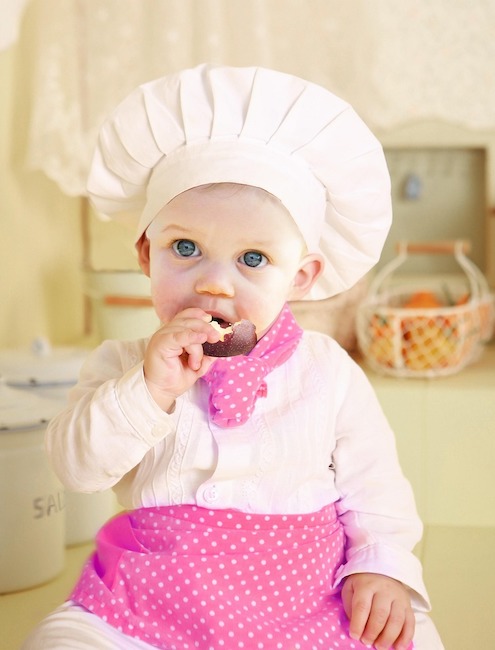
Shows a baby girl eating a piece of apple while sittiing on a counter wearing chef whites with a pink scarf and a pink skirt.

Encourage them to try a variety of mild spices and flavors yet try to avoid over salting their foods as excess sodium isn’t good for any of us.

By this time many clinicians suggest decreasing breast feeding to 3-5 times per day and formula intake from 29-32 oz. per day to 16-24 oz. per day.

FOODS TO AVOID

Some foods are just too risky and can increase the risk of choking. These include popcorn, whole nuts, whole grapes or any hard foods until at least the age of three.

Beyond this age parents and care providers need to continue to observe them while eating in case of an unexpected choking event.

BE PREPARED, JUST IN CASE!

Parents, family members, and care providers need to be prepared in case of a true choking event. All adults who care for little ones must take a CPR course to learn how to resolve this emergency. Remember, paramedics will never be there in time to assist in a severe choking episode.

Why Does My Nanny Need CPR and First Aid Training?

The question posed above is a good one. The answer I usually provide anyone who asks why their caregiver needs a life-saving course is: “Do we really have control over when bad events occur at home or anywhere else?” That answer suggests that parents stop and think about this issue. Their answer is usually self-evident. Of course we don’t.
Emergencies in the home have little or no warning as to when they will occur. This is why we emphasize the importance of two main areas: Prevention and, if and when needed, action.

The program offered by Save A Little Life ™ addresses and re-focuses on these two critical areas. The responsibilities we give our nannies/care-providers are awesome. They are not only your eyes and ears when parents are away from home, they really need the exact same understanding of how we prevent and, importantly when and how we act.

Simply and accurately put, they perform the most important job you will ever hire for. The vast majority of your home based help are smart, interested and utterly committed to your infant, toddler and child’s well-being. It is the parent’s job to make sure you are leaving your little ones in prepared hands.

First Aid and little ones

The first-aid component of the course is far more likely to be required. Cuts, bumps, splinters, head bonks and the like are quite common. Our experienced instructors review the most common of these incidents so that your nanny will be able to be decisive in their action. These actions may include:

* Responding to the more minor incidents noted above.
* Be able to understand when an injury, for example, needs the parent’s attention right away.
* Should be confident in explaining a situation that has occurred and do so succinctly and in a timely way.
* The competent use of first-aid supplies provided by the parent at home or elsewhere.
* Do their best to identify injuries or accidents that may require a visit to the E.R.
* Quickly identify higher risk concerns in or near your home where quick action may be needed to safeguard your small ones.

What we do

Save A Little Life ™ specializes in Pediatric CPR and First Aid for families and caregivers. Ask us about family discounts for those who have taken our class recently and need to have a caregiver trained too. Don’t wait!

Our next two certification courses are as follows:

Westside Nannies (En Espanol)
July 15, 2017
(Ask about our Special for this class, now through June 13, 2017!)
Westside Nannies (English)
July 22, 2017
Parents are welcome too, of course!

Have a safe and prosperous summer
Richard Pass, RN ,BS
Founder and Owner of Save A Little Life, inc.

Having been very involved in both of my daughters’ extracurricular activities, I found that basic first aid is more than helpful, it’s a must!

In our case, my kids played soccer and softball, rode bikes, zoomed on skateboards and much more. On occasion, one or the other took a tumble from that bike or skateboard, bonked heads with another kid on the soccer field, got stung by a bee or got an accidental poke in the eye.

 Since we know that minor injuries occur with regularity for children of all ages, the question is: Are we ready with adequate first-aid supplies and do we know how to use them?

 Save A Little Life not only offers the highest quality in CPR training, but we are specialists in first-aid response and have an excellent basic first-aid class just for you.

Those who attend our first-aid course will learn the following skills:

•    How to control bleeding
•    How to manage a burn
•    How to stabilize a bad sprain or fractured bone
•    How to safely irrigate a wound or eye
•    The basics of bandaging wounds
•    Dealing with insect or animal bites
•    Response to poisonings
•    How to assist a victim of a seizure
•    How best to evaluate a head injury victim

Our First Aid course is a hands-on program where all participants work with real First Aid materials under the supervision of a trained critical care or emergency department R.N.

 Knowing how to respond to urgent care problems requires the ability to remain as calm and self-assured as possible. The goal of our program is to help you gain confidence in managing many of the minor to moderate injuries when and where they occur.

These classes are a must for all parents, family members and care providers.

Check our Calendar for upcoming classes, or contact us at (818) 344-1442.

And be sure to check out our Family First Aid Kits.

Regards,

Richard Pass, RN,BS

Director, Save A Little Life, Inc.