This study, recently published in the Journal Pediatrics, attempted to examine the relationship between length of infant sleep and expected levels of growth and development in various aged infants and children. The phrase “sleeping through the night” has had different meaning depending on what era and/or whose criteria one used. The most current definition is… “the longest period of uninterrupted sleep without parental intervention.”
In the past, other criteria were considered, including “total nocturnal sleep” (total of hours slept during the night) or “total sleep duration” (number of hours slept in the last 24 hour period.)
Using their criteria of 6 to 8 hours of uninterrupted sleep, the authors discovered that 27.9% to 57% of infants (6 to 12 months old) did not sleep through the night. (Our italics) In addition, this study found that 43.4% of 12 month olds did not sleep through the night as well. Using well-developed study criteria, the authors found that, despite less than “optimal” sleep, these infants had normal physical and emotional development.
Maternal mood was another important consideration of this research as well. These assessments were done in the 3rd trimester, at 6, 12 and 36 months postnatally. Items on the scale reflect frequency of symptoms in the previous week. Given the many differences in households, the research also looked at issues of maternal education, income and socioeconomic status. Issues of maternal depression, infant gender and breastfeeding were factored in as well.
Their conclusion states: “Considering that high proportions of infants did not sleep through the night and that no associations were found between uninterrupted sleep, mental or psychomotor development, or maternal mood, expectations for early sleep consolidation could be moderated.”
As always, we want you to seek the advice of your pediatrician on all issues of pre and postnatal care…for both your baby and yourself!
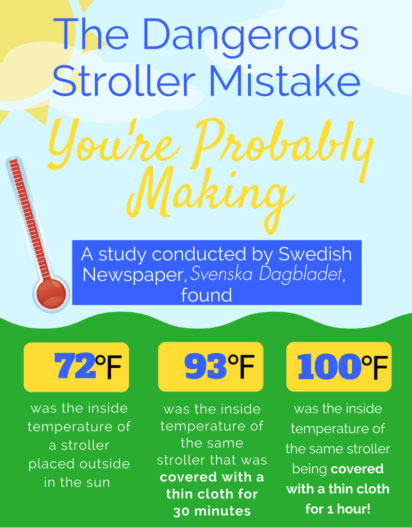 Based on an interview with Stockholm pediatrician Dr. Svante Norgren about the dangers of covering a stroller, the Swedish newspaper, Svenska Dagbladet, conducted an experiment by putting a stroller out in the sun, midday, in the summer. Without a cover, the stroller was about 72 degrees Fahrenheit. After covering the stroller with a thin cover for 30 minutes, the temperature rose to 93 degrees and after an hour, 100 degrees!
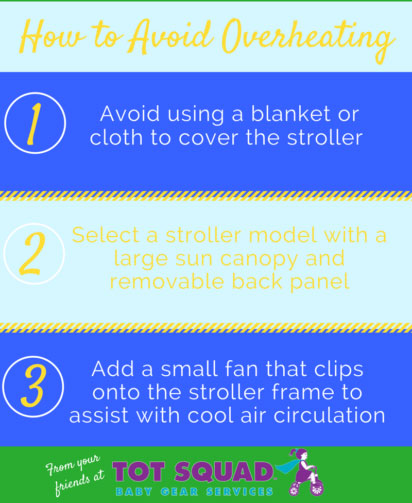 Dress children lightly, use plenty of sunscreen, and keep them well-hydrated. Sponge your child with a damp cloth to keep them comfortable. A small clip-on fan can be attached to their stroller for added circulation – just be sure to keep it out of reach.